How to Verify Breaking News on Social Media Before You Share It
A bridge collapses. A minister resigns. A bank freezes withdrawals. Within minutes the claim is in your feed, attached to a photograph that looks convincing and a caption that says "confirmed". Some of it will turn out to be true. Some will be a photo from another country, another year, another disaster entirely. The gap between helping and spreading a falsehood is usually less than a minute of work — and it starts before you touch the share button.
Start by restating the claim in one sentence
Before you check anything, write the claim out in your own words: "This video shows a fire at a chemical plant in Lyon this morning." That single act exposes holes. Plenty of viral posts never actually say where, when, or according to whom — they simply imply it. If you cannot put the claim into one plain sentence, you cannot check it, and you should not share it.
It also helps to name what kind of claim you are looking at. Is it an alleged fact, a prediction, an opinion dressed as reporting, or a joke that has escaped its original context? Each one needs a different kind of evidence. A joke reposted without its punchline can look like a news alert by the third share.
Find the original post, not the retweet
Screenshots of posts, which are themselves screenshots, are the most common way false claims travel. Ask three questions in order. Who said this first? What kind of account is that? And does the claim exist anywhere other than social media?
Look at the account behind the original post. Was it created last week? Does the bio say "parody" or "fan account"? Is it posting a dozen "breaking" items an hour across unrelated subjects? A profile picture borrowed from a stock site or a public figure is a warning sign, not proof of anything on its own.
Watch the attribution. "Reportedly" and "sources say" mean nothing without a named source, and often they mean the poster is repeating another unverified post. Then go one step further down the chain: for a headline, open the outlet's own website and find the article, because headlines get rewritten and screenshots do not. For an official claim, look for the primary document — the police or fire service statement, the company's own notice, the regulator's feed, the court record. Institutions usually publish on their own channels before anyone else quotes them accurately.
Timestamps, timezones and the problem with "just now"
Old footage resurfaces with every new disaster. A clip of flooding from three years ago gets a fresh caption; a fire from another city becomes "downtown right now". The word "breaking" in a caption does not make anything new.
Check the date on the original post, not the date on the share you saw. Weather is a useful cross-check: heavy coats in July, green leaves in a news report about a winter storm, dry ground in a story about a flood. So is light. A clip filmed at dusk cannot be from an event that happened at noon, whatever the caption claims. And remember timezones — "this morning" written in Jakarta is not your morning, and a claim can look premature or stale simply because you are reading it from another part of the world.
Interrogate the image before you trust the caption
Reverse image search is the fastest tool available and it costs nothing. Crop out the caption, arrows and text overlays first, then search the clean part of the picture. If the image appears in articles from years earlier, or from a different country, you have your answer.
Then read the picture itself for clues the caption ignores:
- Signage, shop names and street furniture in a language that does not match the claimed location.
- Number plates, road markings and traffic lights that follow a different country's system.
- Watermarks, agency logos or a broadcaster's chyron that no one bothered to crop out.
- Shadows pointing in inconsistent directions, or a crowd whose clothing fits a different season.
Video needs one extra step: listen. Audio is often lifted from a completely different event and laid over silent footage, and it is frequently the part people remember. Watch for loops, hard cuts and clips that end just before anything identifiable appears. Metadata is usually stripped by social platforms, so the uploader's history is more useful than the file itself — has this account posted the same footage before, under a different caption?
Cross-reference — and check that your sources are truly independent
Two accounts repeating the same wire copy are one source, not two. Real verification means finding reporting that could not have come from the same place: a local newsroom near the scene, a reporter posting from the street, an agency photographer, a statement from the institution involved.
Ask whether each source could plausibly know what it is claiming. A sports account announcing a central bank decision, an anonymous account with a scrolling feed of disasters, a Facebook page named after a city but run from elsewhere — none of them can be the basis for a share. Also check for denials. Sometimes the quickest way to settle a rumour is to find that the organisation has already said it is false.
Popularity is not evidence. A post with forty thousand shares has been shared forty thousand times; that is all it tells you.
The patterns that catch careful people
Most false breaking news is not clever. It works because it arrives when you are moved, hurried or angry. Watch for these:
- Urgency that discourages checking: "share before this is deleted", "the media won't report this".
- No named person, document or institution behind the central claim.
- Numbers with no unit, no date and no comparison — dramatic and unverifiable.
- Quotes with no context, typically a fragment that reverses the speaker's meaning.
- Photographs of documents with no letterhead, page number or case reference.
- Lookalike accounts using an official logo and a slightly misspelled handle.
Say what you don't know, and correct yourself in public
You do not have to wait for perfect certainty to speak. You do have to be honest about the state of your knowledge: "reports of an incident on the ring road, not yet confirmed by police" is a responsible post. "Confirmed" is not, until something has confirmed it.
If you shared something that turned out to be wrong, correct it in the same place and with the same energy as the original post. Quietly deleting leaves the false version circulating without your correction attached to it.
One more caution: where a claim touches health, money or the law — a rumoured contamination, a failing bank, a new rule — do not act on a social post. Wait for official guidance and, where it matters, take professional advice before you do anything irreversible.
A one-minute checklist before you share
- Restate the claim in one sentence, with a place and a date.
- Find the original post, not the screenshot of it.
- Check the account and the timestamp on the original.
- Reverse image search the picture, cropped clean of overlays.
- Look for one independent source that could not be copying the others.
- Ask what the institution involved has said — including any denial.
If two of those steps fail, the honest move is to wait. The story will still be there in ten minutes, and so will your credibility.
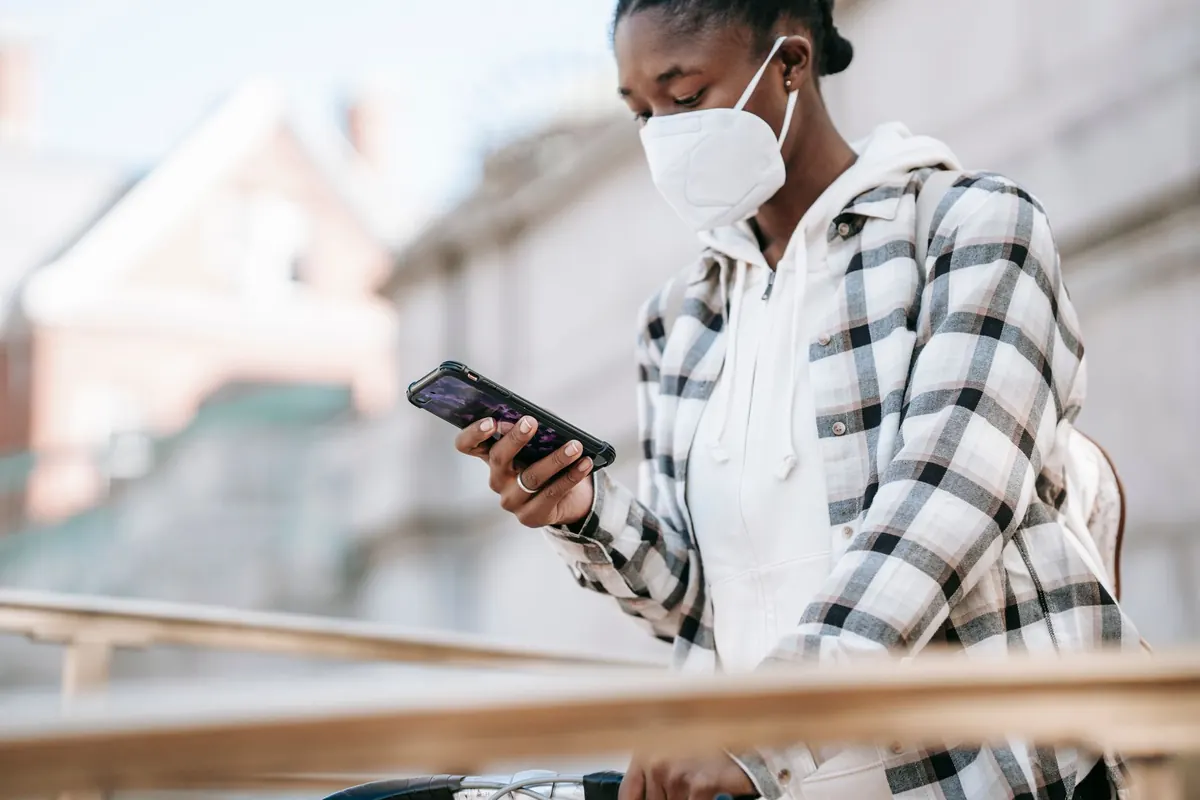
Photo: Charlotte May / Pexels